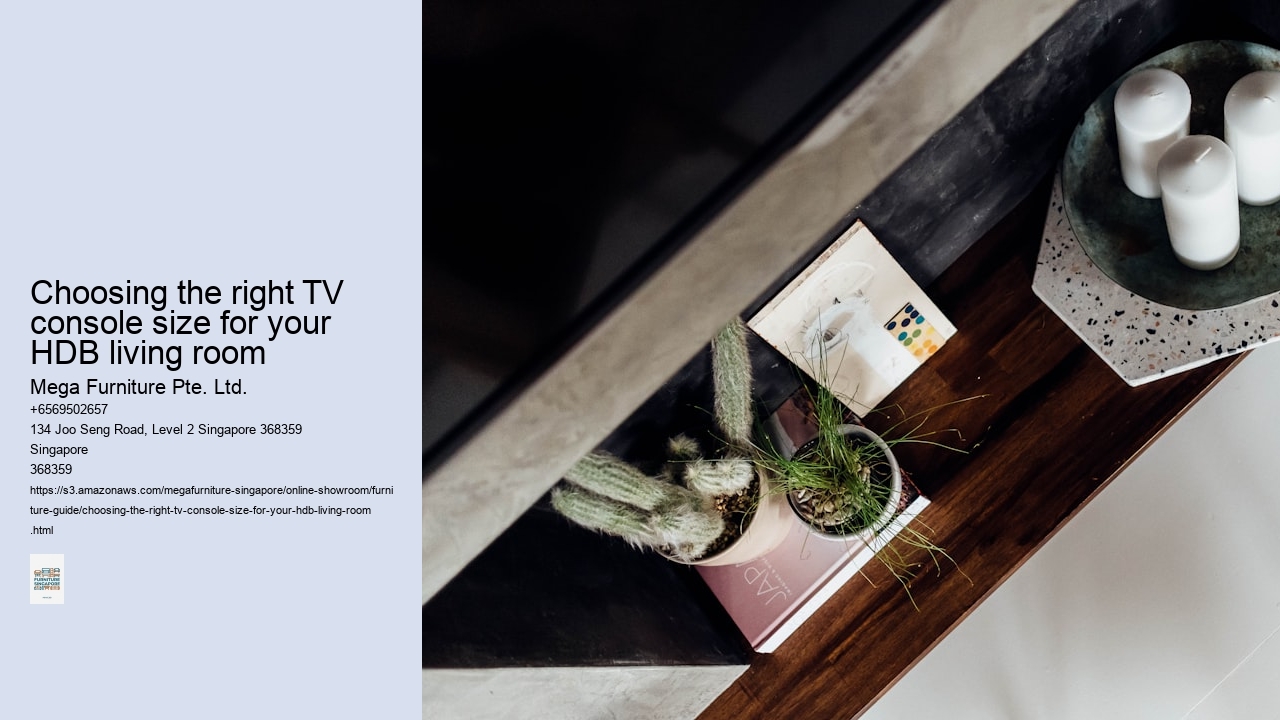
A 75-inch TV mounted on a 150-centimetre console is a common design mistake in condo media walls—it looks like a giant floating head with a tiny neck. The imbalance isn’t just visual; that undersized cabinet forces your AV receiver and gaming console into a cramped, poorly-ventilated corner, which is a recipe for overheating. For a balanced, functional setup, the console’s length must anchor the screen’s visual weight. The rule of thumb is straightforward. A 65-inch screen typically needs a console spanning 180 to 200 centimetres for proper proportion. Scale that up for the increasingly popular 75-inch models, and you’re looking at a minimum of 220 centimetres. Anything shorter starts to feel top-heavy and precarious, especially against the clean lines of a built-up media wall in a 4-room condo living room. That extra length isn’t merely aesthetic; it provides the necessary real estate for proper component organisation. Think beyond just the TV box. A modern media setup includes a soundbar, a game console or two, maybe a set-top box, and the essential AV receiver with its need for breathing room. A 220-centimetre console offers dedicated compartments and open bays to separate these items, preventing a tangled nest of cables and allowing heat to dissipate. It’s the difference between a curated display and a cluttered electronics dump. While a longer unit commands more wall space, it actually organises a room better. In many condo layouts, a properly scaled console can stretch to define the entire living zone, with its surface accommodating decorative objects that ground the television. You’re not just buying furniture; you’re establishing a proportional focal point. For those measuring up, browsing a comprehensive
TV console collectionis the practical first step—filter by the 220cm+ lengths to see options that truly work.
It’s a classic choice that warps in Singapore’s climate. Solid teak or oak will swell and distort after a few monsoon seasons, especially in ground-floor units near Bedok Reservoir or older flats without dehumidifiers. The cabinet doors on a long console will start sticking, and that beautiful finish will cloud with moisture. You’ll spend more time maintaining it than enjoying it. For a TV console that sits low to the floor, where humidity pools, it’s simply not a practical long-term material.
High-pressure laminates are the default for a reason. They’re engineered to resist moisture absorption completely, which means no swelling at the edges even in a humid Pasir Ris living room. The surface is also incredibly easy to wipe down after a child’s juice spill or a pet’s slobber. Modern finishes can convincingly mimic wood grain or concrete, so you don’t sacrifice aesthetics. For a 180cm console in a BTO, it’s the most sensible and budget-friendly workhorse material you can choose.
This is the exception that proves the rule for solid wood. Rubberwood is kiln-dried and chemically treated to stabilise it against tropical humidity, making it a viable option if you’re set on a natural timber look. It’s typically found in more affordable, rustic-style consoles. The treatment helps, but it’s still not as impervious as laminate—you’ll want to keep it away from direct AC drafts or wet mop splashes. It offers a warmer texture for families who find laminates too cold.
For a truly industrial, minimalist look, powder-coated steel frames are almost bulletproof. The coating fuses to the metal, creating a hard shell that won’t chip or rust from humidity. It’s perfect for the legs and frames of floating TV consoles, where you need strength without bulk. A quick wipe removes dust and pet hair. The only downside is that it can feel austere; you’ll often see it paired with warmer wood or laminate shelves to soften the effect in a family living room.
Scratch-resistant finishes aren’t a luxury with pets and kids—they’re essential. Look for terms like ‘anti-fingerprint’, ‘textured’, or ‘matte’ on laminate surfaces; they hide scuffs from dog claws or toy cars far better than a high-gloss piano finish. Rounded corners on the console’s frame are a non-negotiable safety feature in a cramped 4-room layout. That little bit of extra engineering means you won’t be rushing a toddler to KK Hospital after an unfortunate stumble during playtime.
A perfectly measured TV console can still look like an afterthought when it’s propped an inch off the wall, leaving a sliver of shadow where the skirting board protrudes. It’s a classic HDB oversight — buyers measure the alcove width but forget the standard 2cm skirting, resulting in a console that can’t sit flush. That gap becomes a dust trap and a cable runway, undermining the clean, built-in look most are after. Always deduct the skirting depth from your wall measurement, or opt for a wall-mounted unit that clears it entirely.
Just as common is the last-minute scramble for power points. You’ve centred your 180cm console beautifully, only to realise the nearest socket is behind the far-left leg, forcing a daisy-chain of extension cords across the back. Plan your cable management before the console arrives: identify where your router, modem, and power strip will live, and ensure the console design accommodates them. Many modern units have rear cable ports and dedicated vertical channels, but they’re useless if they don’t align with your infrastructure. It’s worth mapping your outlets on the floor plan with masking tape — a tedious five minutes that saves hours of frustration later.
Then there’s the matter of mass and light. In many north-facing living rooms in BTO blocks, natural light is a diffused, cool commodity that gets swallowed by dark, bulky furniture. Choosing a deep, espresso-stained console in such a space can anchor the room too heavily, making a 4-metre wall feel closer to three. Lighter materials like oak or washed walnut, or even a slim, open-frame design in a matte finish, help maintain a sense of airiness. The console should frame the TV, not compete with it for visual weight.
Ultimately, the most frequent mistake is treating the console as an isolated purchase rather than the central component of a system. Its depth dictates viewing distance, its storage dictates clutter, and its finish dictates the room’s mood. Getting it right means considering the skirting, the wires, and the light all at once — because in a Singaporean living room, every centimetre and every lumen counts. You can explore a range of solutions designed for local spaces, from floating styles that clear skirting to models with integrated cable management, at Megafurniture’s collection.
The online image of that sleek oak-veneer console rarely matches reality — it’s the weight of a drawer as it glides shut that tells you whether it’ll survive a five-year-old’s daily raid for game controllers. Screen saturation can make even laminate look like solid timber, but in a Tampines showroom, you’ll run a hand over the surface to feel the grain texture, spot the subtle colour variation between panels, and judge if that light grey finish has a pinkish undertone that’ll clash with your existing media wall. This physical verification is critical; what’s listed as ‘charcoal’ online might read as flat black under your BTO’s LED downlights, turning a design centrepiece into a visual dead zone.
Assessing structural integrity demands a hands-on approach. You’ll want to test the rigidity of those cantilevered floating shelves by applying some pressure, or check the stability of a floor-standing unit on your own uneven parquet. More importantly, you can inspect the cable management gaps at the back — are the cut-outs large enough to thread a soundbar power brick and multiple HDMI cables through, or will you be forced into a messy, visible tangle? These are dimensions and details product specifications routinely omit, yet they define daily function in a 4-room flat’s living area.
The mechanics of storage are another blind spot for digital shoppers. Smooth, soft-close drawer mechanisms are a silent luxury in a family living room, while stiff, rattling glides become a persistent annoyance. At the Joo Seng showroom, you can test each drawer’s action, feel the sturdiness of the dovetail joints, and see if the internal partitions are actually useful for organising remote controls and charging cables. It’s the difference between furniture that simply holds your PlayStation and a console that organises your entire entertainment ecosystem seamlessly.
Ultimately, committing to a piece that might anchor your living room for a decade warrants the trip. You’re not just confirming a colour swatch; you’re evaluating an object’s physical presence in a space much like your own. Spending twenty minutes in the showroom can prevent the logistical headache and cost of returning a unit that looked perfect online but feels all wrong at home. View the range in person at Megafurniture’s showrooms to move beyond pixels and into the tangible details of material, balance, and craft.
The delivery crew will often measure your lift landing before they even bring the item up—that’s the first sign you’re dealing with a proper service. In older HDB blocks around Queenstown or Toa Payoh, lift dimensions can be a genuine constraint; a 240cm TV console flat-packed is one thing, but a fully assembled, floor-standing unit simply won’t fit through a 90cm-wide door. Always confirm ‘two-man’ delivery includes on-site assembly in your living room, not just a doorstep drop-off. You don’t want to be the person trying to manoeuvre a solid wood media console up a narrow staircase.
Assembly itself is usually straightforward, but it pays to be specific. Ask if the team will place the console in its final position, attach any floating mounts to your feature wall, and level it properly. In a 4-room BTO, that final placement against the living room wall is crucial—once it’s loaded with a 65-inch TV and soundbar, you won’t want to shift it an inch.
Warranties here follow a fairly standard pattern. Expect a 12-month period covering manufacturing defects like faulty drawer glides or veneer peeling. The catch is labour; repair or replacement visits often incur a separate charge, unless the fault is egregious. It’s a pragmatic system that keeps initial costs down but means a wobbly leg might still cost you $80 for a technician’s trip from their Jurong workshop.
Read the terms carefully. Some warranties are voided if you attempt your own repairs or if the console is placed in a perpetually damp environment—a real consideration for ground-floor units in older estates. That mild opinion? A one-year warranty is the baseline, not a bonus; any retailer offering less isn’t worth your time.
For peace of mind, look for clear documentation on what’s covered and the process for lodging a claim. Keep your invoice handy, and maybe snap a photo once assembly is complete. When everything is finally set up, from the cable management at the back to the decorative items on the open shelving, that’s when the real test begins.
The questions from buyers in showrooms are less about style and more about hard logistics — it’s the nitty-gritty of fitting a piece into a specific HDB life. They’ve measured their TV wall, they know their robot vacuum model, and they’re thinking about the condensation dripping from the aircon unit above. That’s where the real decision happens.
How high should the console be for robot vacuum clearance? Most robot vacs need at least 10cm, but 12cm is a safer bet for bulkier models. A standard console leg height sits around 15cm, which is generous; a floating design or a unit with a solid plinth base, however, often leaves just a 5cm gap that’s a complete no-go. Check your vacuum’s specs, then add a centimetre for the inevitable rug fringe.
Can it withstand aircon condensation? Does the white finish yellow? Direct, constant moisture from a leaky unit will damage any wood composite over time — positioning is key. For the white finish, modern laminates and painted MDF are fairly stable against yellowing from indirect light, but that cheaper, glossy plastic laminate in a sun-drenched window might not be. A satin or matte finish in a light oak or grey often shows less ageing, frankly, and hides dust better too.
Will a 240cm console fit up a BTO service lift? It’s tight. The diagonal is your friend. Service lift dimensions vary, but a typical BTO lift door is about 90cm wide by 210cm tall — a 240cm length can be angled through if the unit’s depth is slim, say under 40cm. Always confirm the item’s packed dimensions with the retailer, not just its assembled size, and factor in the delivery team’s skill. Many will tell you it’s easier to haul a long box up the stairwell than to risk a costly scratch in a metal box.
The most organised buyers arrive at the showroom with a folded A4 sheet, not just a vague idea. That paper holds three concrete things: a floor plan with the console’s intended spot marked, the exact width and depth of their new television, and a handwritten list of every item the cabinet needs to swallow. It’s a simple tactic that transforms a browsing trip into a targeted mission.
Start with the room itself. Trace your console’s footprint onto your HDB’s floor plan; a 180-centimetre unit in a narrow 4-room BTO corridor can leave just 90 centimetres for walking space, which feels cramped once the family’s all home. Then, measure your TV—not just the screen, but the full width of its stand. A 65-inch model often needs a console at least 150 centimetres long to look balanced, otherwise it’ll appear precariously perched.
Your item list dictates the interior configuration. If you’re storing a PlayStation, a soundbar, three remotes, and a router, you’ll want a mix of closed compartments and open shelving. For families with board games or children’s toys, deeper drawers or cabinets with full-extension slides become non-negotiable. Write it down; it’s easy to be seduced by a sleek, shallow design only to realise your AV receiver won’t fit.
Finally, set a fixed budget that includes delivery and any potential assembly fees. In Singapore, a well-constructed TV console in engineered wood or rubberwood typically ranges from $1,200 to $2,400, with delivery adding another $80 to $150 depending on your neighbourhood. Locking this figure in upfront narrows your search to two or three viable options, allowing you to compare finish quality and storage mechanics in person without budget creep. You can then visit a showroom to assess the grain of a sintered stone top or the smooth action of soft-close hinges on your shortlist.
A common misstep in HDB living rooms is ordering a console that looks perfect online, only to have it dominate the entire TV wall. The standard 4x5 metre HDB living room is a tight equation; with a typical TV wall width of just 3.6 metres, every centimetre of console depth directly competes with your walkway. Exceed 45cm in depth, and you'll likely find yourself sidestepping the furniture every time you cross from the main door to the bedrooms-a daily irritation that undermines the room's flow.
Console depth becomes the critical, and often overlooked, measurement. While length is chosen to match your TV's proportions, depth dictates liveability in these compact spaces. A shallow 35cm to 40cm profile is the sweet spot for many flats, allowing enough room for a soundbar and essential media boxes without impeding circulation. That extra 5cm might seem trivial on a spec sheet, but in a narrow walkway, it's the difference between comfortable passage and a constant shin hazard.
This is why your specific floor plan, not just room type, is the essential first step. A 4-room BTO resale flat in Tampines might have a slightly recessed wall, while a 5-room condo in Bedok could feature an open-plan layout that allows for a deeper unit. Before you even browse a gallery, measure your actual available wall space, mark out the footprint with masking tape on the floor, and live with it for a day. You'll quickly feel if a 240cm long, 50cm deep console is a statement piece or a spatial mistake.
Material choices can also subtly influence perceived scale. A console in a light oak or washed walnut finish tends to feel less imposing against a feature wall than a unit in dark stained rubberwood. Similarly, a floating design or one with slender, tapered legs creates a visual buffer of floor space beneath it, making the overall footprint feel lighter-a smart optical trick for those 3.6 metre walls where every trick counts.
For those working with particularly constrained layouts, the entire storage strategy may need rethinking. The classic long, low cabinet might cede to a wall-mounted media shelf or a compact sideboard repurposed for the task, prioritising clear floor space above all. It's a trade-off: you lose concealed storage but gain a living room that breathes.
A common misstep in HDB living rooms is ordering a console that looks perfect online, only to have it dominate the entire TV wall. The standard 4x5 metre HDB living room is a tight equation; with a typical TV wall width of just 3.6 metres, every centimetre of console depth directly competes with your walkway. Exceed 45cm in depth, and you’ll likely find yourself sidestepping the furniture every time you cross from the main door to the bedrooms—a daily irritation that undermines the room’s flow.
Console depth becomes the critical, and often overlooked, measurement. While length is chosen to match your TV’s proportions, depth dictates liveability in these compact spaces. A shallow 35cm to 40cm profile is the sweet spot for many flats, allowing enough room for a soundbar and essential media boxes without impeding circulation. That extra 5cm might seem trivial on a spec sheet, but in a narrow walkway, it’s the difference between comfortable passage and a constant shin hazard.
This is why your specific floor plan, not just room type, is the essential first step. A 4-room BTO resale flat in Tampines might have a slightly recessed wall, while a 5-room condo in Bedok could feature an open-plan layout that allows for a deeper unit. Before you even browse a gallery, measure your actual available wall space, mark out the footprint with masking tape on the floor, and live with it for a day. You’ll quickly feel if a 240cm long, 50cm deep console is a statement piece or a spatial mistake.
Material choices can also subtly influence perceived scale. A console in a light oak or washed walnut finish tends to feel less imposing against a feature wall than a unit in dark stained rubberwood. Similarly, a floating design or one with slender, tapered legs creates a visual buffer of floor space beneath it, making the overall footprint feel lighter—a smart optical trick for those 3.6 metre walls where every trick counts.
For those working with particularly constrained layouts, the entire storage strategy may need rethinking. The classic long, low cabinet might cede to a wall-mounted media shelf or a compact sideboard repurposed for the task, prioritising clear floor space above all. It’s a trade-off: you lose concealed storage but gain a living room that breathes.